Murex Shells (Muricidae): Spines, Varices, and Specimen Care
A practical guide to Muricidae murex shells, covering varices, spine architecture, siphonal canals, apertures, and careful specimen handling.
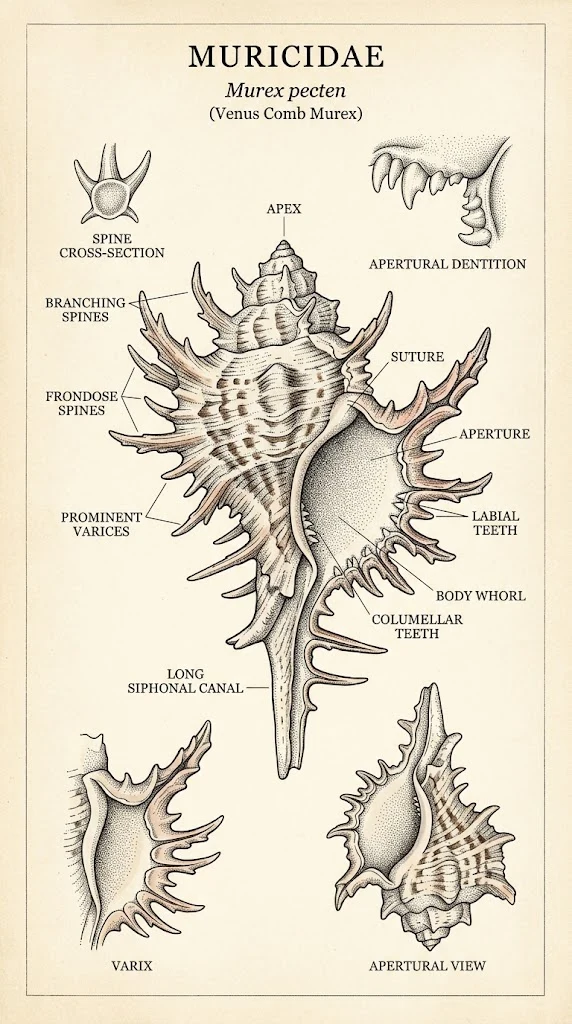
The family Muricidae includes shells with some of the most complex three-dimensional architecture in marine malacology. Varices, spines, fronds, and webbing can help distinguish taxa and may contribute to defence, camouflage, or stability, but their form and function vary across the family.
For collectors, a murex is both a display specimen and a fragile structure. The tips of secondary spines and the edge of the siphonal canal are particularly vulnerable to damage during collection, cleaning, and transport.
Diagnostic architectural features
Use several features together when comparing a muricid shell:
- Varices: Thickened axial ridges that commonly mark repeated growth pauses or lip formation. The number and strength of varices can be useful within a genus, but there is no single varix count for the whole family.
- Spine morphology: Describe spines as simple, branching or frondose, wing-like, or connected by thin webbing. Examine both the spine base and the tip so natural growth is not mistaken for a break.
- Siphonal canal: Record its length relative to the body whorl, whether it is open or partly closed, its curvature, and whether spines continue along the canal.
- Apertural dentition: Inspect the labial teeth, columellar edge, anal notch, and callus where present. These features can support identification and maturity assessment, but should not be used without shell shape and locality.
- Sutures and sculpture: Note the depth of sutures, spiral cords, nodes, and changes in sculpture between whorls.
Representative Muricidae species
| Species | Diagnostic highlights | Broad habitat or region |
|---|---|---|
| Murex pecten ([Lightfoot], 1786) | Very long siphonal canal with many long, comb-like primary and secondary spines. Compare the spacing and integrity of the spines rather than relying on a fixed count. | Indo-West Pacific sandy or muddy bottoms |
| Chicoreus ramosus (Linnaeus, 1758) | Large and heavy, usually with three major varices per whorl carrying large, leaf-like frondose spines. Aperture colour can vary. | Indo-Pacific coastal and reef habitats |
| Hexaplex cichoreum (Gmelin, 1791) | Several prominent varices, often six or more per whorl, with a shorter to moderate siphonal canal and frilled sculpture. | Indo-West Pacific |
| Pteropurpura festiva (Hinds, 1844) | Three swept-back, wing-like varices with limited sharp spines and fine concentric colour lines. | Eastern Pacific rocky coasts |
The supplied Muricidae plate features Murex pecten. Its labels are useful for locating varices, branching spines, the aperture, labial teeth, columellar teeth, and siphonal canal.
Specialized cleaning and handling
Murex shells trap sand, calcareous deposits, and marine growth in the spaces between spines. Treat the structure as fragile before choosing a method:
- Document first: Photograph the shell and record any detached tips, old adhesive, encrustation, or previous treatment.
- Start mechanically and gently: Use a blower and a soft brush first. If a stable shell has hard deposits that must be removed, work under magnification with a soft or wooden pick before considering a fine metal tool. Never lever against a spine or the edge of the canal.
- Restrict ultrasonic cleaning: An ultrasonic cleaner is not a general-purpose step. Never use it on thin shells, long or branching spines, loose layers, fragile protoconchs, or shells with old repairs. Only a durable, stable specimen should be considered for a short, controlled cycle after risk assessment.
- Avoid chemical shortcuts: Do not use acids, bleach, boiling water, abrasives, or routine mineral-oil coatings on the shell surface. These can etch, weaken, darken, or conceal the natural condition of the specimen.
When buying or trading a murex, inspect the tips of the siphonal canal and primary spines closely. Under the bbshells house scale, any filing, glue, epoxy reconstruction, or chemical alteration must be disclosed and affects the condition grade. See the Shell Specimen Grading Guide and Shell Cleaning and Preservation Guide for related records.