Cowrie Shells (Cypraeidae): Identification & Preservation Guide
A practical guide to identifying cowrie shells by apertural teeth, fossula, margins, growth stage, and natural enamel, with notes on safe preservation.
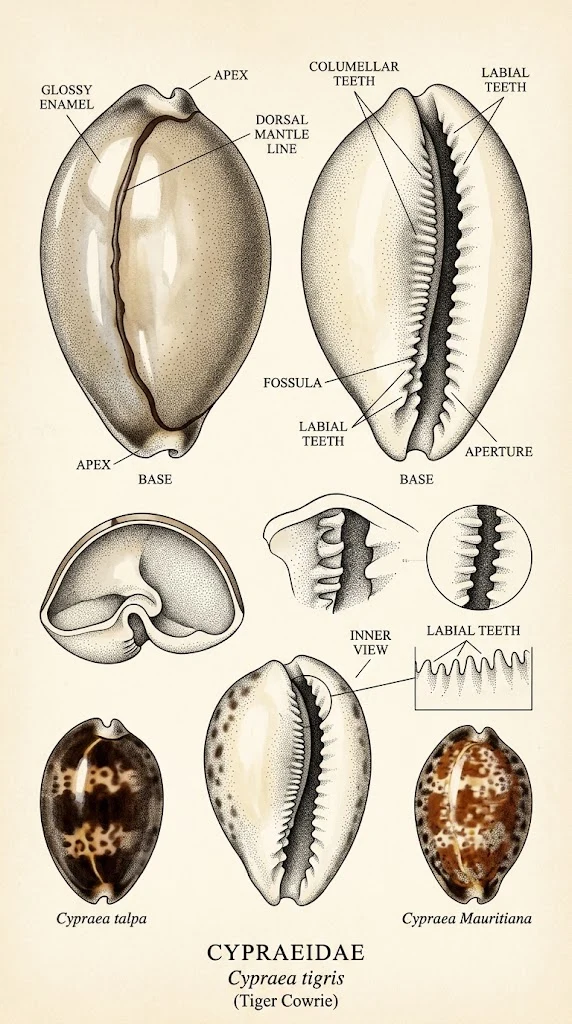
Cowries (family Cypraeidae) are gastropods known for their smooth, highly polished shells and distinctive toothed apertures. Colour is useful for comparison, but reliable identification also depends on the shell outline, margins, base, teeth, and developmental stage.
Core diagnostic features
When examining a cowrie specimen, record several structural features together:
- Apertural teeth: Compare the number, spacing, relief, and colour of teeth on the labial and columellar lips. Teeth are important clues, but should be read alongside shell proportions and locality.
- Fossula: This is a depression near the anterior part of the columella. Its shape, depth, and denticulation can help separate similar species, although it can vary with growth and wear.
- Margins and callus: Inspect the thickness, colour, spotting, and contour of the margins and base. Mature shells often develop stronger margins, but the degree of callus varies among species and individuals.
- Dorsal mantle line: On a living cowrie, this line is formed where the two mantle lobes meet over the dorsum. It may correspond to a visible pattern on some shells, but it is not a dependable feature on every cleaned empty shell.
- Overall form: Aperture width, dorsal inflation, base shape, anterior and posterior ends, and tooth development should be compared as one set of characters.
Understanding growth stages
Cowrie shells change substantially during growth. A juvenile shell can look unlike the adult form, so identification and condition grading should account for ontogeny:
- Bulla-like juvenile stage: The shell is relatively thin, the lip is not fully formed, and apertural teeth may be weak or absent. Pattern and sculpture are often incomplete.
- Subadult stage: The outer lip begins to thicken and curve inward, while the columellar and labial teeth become more distinct.
- Adult stage: Margins, base, and apertural dentition are usually fully developed. Adult characters are often easier to compare, but some juveniles can still be identified with appropriate references.
Do not grade a juvenile shell as though it were a fully mature specimen. Record the apparent growth stage separately from surface condition.
Representative Cypraeidae species
| Species | Diagnostic highlights | Broad range |
|---|---|---|
| Cypraea tigris (Linnaeus, 1758) | Large and ovoid, with a pale ground colour, contrasting dorsal spotting, a broad base, and a strongly toothed aperture. Pattern and size vary across its range. | Indo-Pacific coastal waters |
| Mauritia mauritiana (Linnaeus, 1758) | A robust cowrie with a dark dorsal surface, lighter spotting, thick margins, and a strongly toothed base. Compare the outline and base with related Mauritia forms. | Broad Indo-Pacific range |
| Callistocypraea aurantium (Gmelin, 1791) | The golden cowrie, recognised by its orange to golden shell, substantial margins, and toothed aperture. Older literature and plates may use the combination Lyncina aurantium. | Western Pacific island waters |
| Monetaria moneta (Linnaeus, 1758) | Small and smooth, usually pale to yellowish, with a compact outline and toothed aperture. The species has a documented history of use as shell currency. | Indo-Pacific shallow coastal habitats |
Older plates may use historical combinations or spellings. For example, a plate labelled Cypraea Mauritiana should be checked against the current name Mauritia mauritiana before it is entered in a catalogue.
Preservation and curation
The glossy surface of a cowrie is part of its natural outer layer. It should be preserved, not recreated with a coating.
- Never expose a cowrie to acids, bleach, boiling water, abrasives, or polishing compounds.
- Do not apply mineral oil to glossy or enamelled cowries. Oil can change reflectivity, darken the surface, collect dust, and obscure treatment history.
- Start with a soft dry brush or blower. If a stable, untreated shell needs a water test, use brief contact with clean water on a hidden area and stop if colour transfers or the surface changes.
- Let the shell dry completely at room temperature before storage, and record any cleaning or coating history.
For detailed handling decisions, see our Shell Cleaning and Preservation Guide. For condition notes, see the Shell Specimen Grading Guide, and compare documented examples in the bbshells collection.