Cone Shells (Conidae): Taxonomy and Morphological Guide
A practical guide to cone shell identification using spire, shoulder, protoconch, aperture, and pattern, with essential safety notes for venomous live animals.
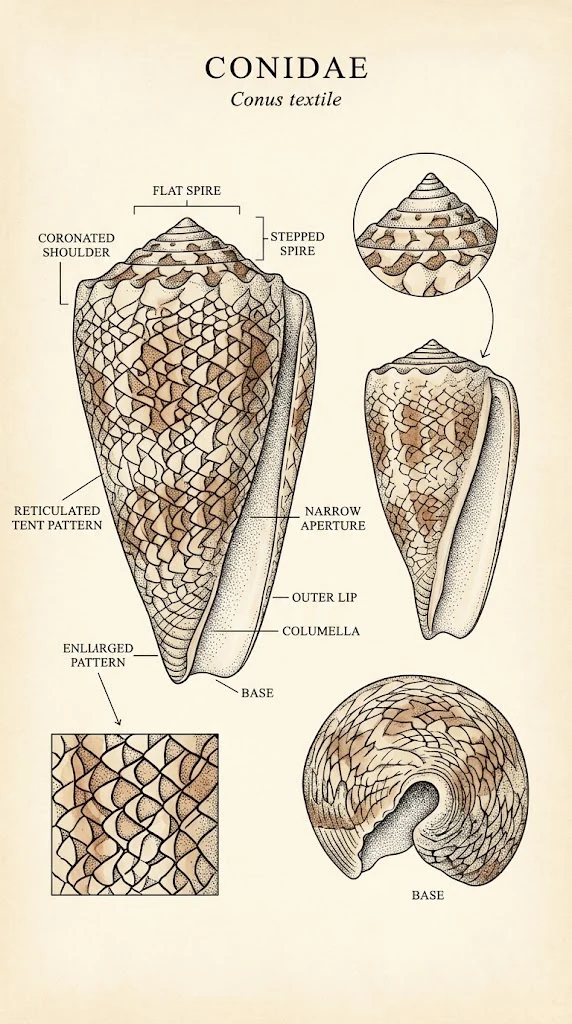
The family Conidae contains many species with a broadly cone-shaped outline, but similar shells can differ in small structural details. Identification should combine shell geometry, aperture, sculpture, colour pattern, locality, and current taxonomic references rather than relying on one visual mark.
Live cone snails can inject venom through a specialized radula. Never handle a live cone snail with bare hands. A dry empty shell is not a venom delivery device, but confirm that the animal is absent before handling it.
Morphological anchors for identification
Start with structural geometry and then use pattern as supporting evidence:
- Spire profile: Describe the spire as low, flat, stepped, or elevated, and note whether it is straight-sided or concave. Spire shape is useful but can vary within a species and overlap between species.
- Shoulder structure: Examine the widest part of the shell. The shoulder may be rounded, sharply angled, or coronated with nodes. Record the strength and spacing of the nodes.
- Protoconch: The embryonic shell at the tip of the spire can be informative when preserved. A paucispiral or multispiral protoconch may provide clues about larval development, but it should not be interpreted in isolation.
- Body whorl and aperture: Record body whorl inflation, aperture width, lip profile, basal outline, and any spiral grooves or fine ribs. Use oblique light or a hand lens instead of running a fingernail across a fragile surface.
The limits of colour pattern
Cone shells may show tent marks, reticulations, longitudinal lines, and spiral bands. These patterns can vary among populations and individuals, and similar patterns may occur in unrelated species. Treat colour as a secondary descriptor and compare it with the spire, shoulder, aperture, locality, and measurements.
Key Conidae species and morphotypes
| Species | Structural diagnostics | Pattern and surface |
|---|---|---|
| Conus marmoreus (Linnaeus, 1758) | Heavy shell with a low to moderately raised spire and a strongly structured shoulder. | Pale ground colour with contrasting dark marks or tent-like patterning; pattern varies across the range. |
| Conus textile (Linnaeus, 1758) | Compact, solid shell with a low to moderately elevated spire and a broad shoulder. | Characteristic textile-like reticulation with brown or yellow tones; compare the aperture and shoulder with close relatives. |
| Conus geographus (Linnaeus, 1758) | Broad, relatively light shell with a low spire and a wide aperture. | Mottled or banded patterning. Live animals are highly venomous and must not be handled. |
| Conus betulinus (Linnaeus, 1758) | Heavy, smooth shell with a flat to low spire, rounded shoulder, and broad aperture. | Pale yellow to orange ground colour with rows of darker spots or dashes. |
The supplied Conidae plate features Conus textile. Its historical illustration is useful for locating the spire, shoulder, aperture, outer lip, and base, but a catalogue entry should still be checked against current references.
Cataloguing and condition assessment
The outer lip of a cone shell is thin and can be damaged during the life of the animal, collection, or transport. A natural growth line is not automatically a defect; record whether the lip is intact, naturally rough, chipped, filed, or reconstructed.
For every specimen, photograph the dorsal surface, aperture, base, apex, and any questionable area. Record locality, size, identification source, and treatment history separately from the condition grade. Any filing, glue, reconstruction, or chemical alteration must be disclosed under the Shell Specimen Grading Guide.
For cleaning decisions, see the Shell Cleaning and Preservation Guide, and compare documented specimens in the bbshells collection.