A Collector's Guide to Bivalves of the Northwest Pacific & East Asia
A field guide to Japan specimen shells, Pectinidae, Yellow Sea records, and the locality details that make Northwest Pacific bivalves useful to collectors.

The Northwest Pacific and East Asia hold an unusually rich range of bivalve forms: scallops with strong radial sculpture, smooth clams with subtle growth lines, ribbed cockles, mussels with dark periostracum, and many local forms that reward careful comparison. This collector's guide is an orientation to the records behind a specimen, not a replacement for a current taxonomic reference.
Start with the shell, then read the locality
Bivalves are two-valved shells joined by a hinge. Before trying to name a specimen, record the features that can be compared later:
- overall outline: round, oval, triangular, elongated, or inequilateral;
- hinge and umbo position;
- radial ribs, concentric growth lines, scales, spines, or nodes;
- auricles and byssal notch where present;
- exterior colour, periostracum, and interior margin;
- maximum length, height, and inflation measured consistently.
The locality record then gives those observations context. “Japan specimen shells” is a useful search phrase, but Japan is not one habitat. A specimen from a sheltered bay, an open sandy coast, a rocky island, or deeper offshore water may have a very different form and collection history. Record the prefecture, island, bay, or broader sea area when known, and avoid turning an uncertain locality into false precision.
Families that reward close comparison
Pectinidae: scallops and fan shells
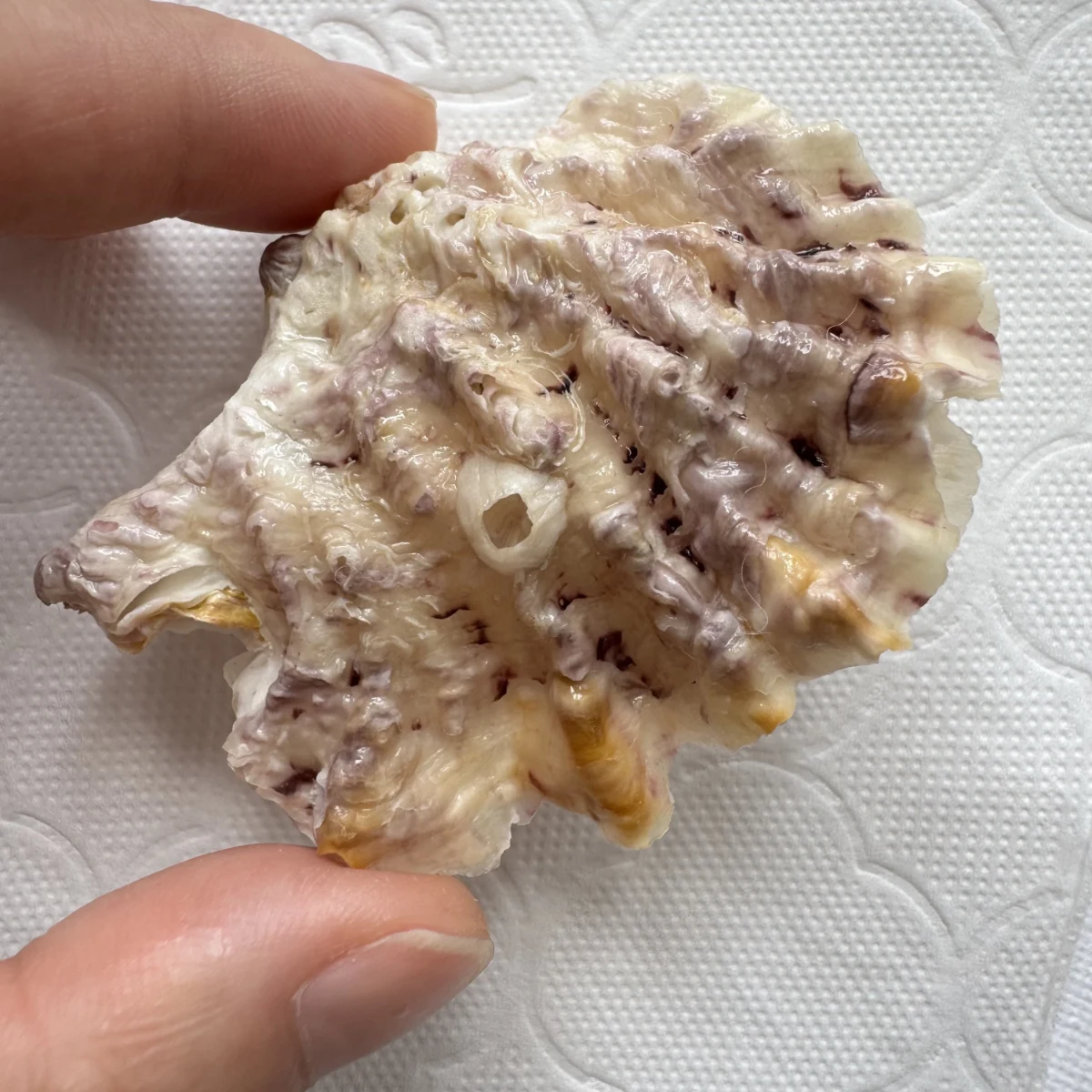
Pectinidae are often the first group people mean when they search for a Pectinidae collector guide. Compare the number and strength of radial ribs, the relative size of the ears, the shape of the byssal notch, and the transition from juvenile to adult sculpture. Colour patterns can be striking, but they should be read alongside hinge characters and measurements rather than used alone for identification.
On a display specimen, check the tips of ribs and ears carefully. These projections can chip during collection and transport. A clean photograph of the exterior, interior, hinge, and edge is more useful than a single frontal image.
Veneridae and other rounded clams
Many venerid shells are rounded or oval and can appear deceptively similar at first glance. Concentric growth lines, posterior shape, lunule or escutcheon development, hinge teeth, and the texture of the inner margin help separate close-looking specimens. Keep the valves together when possible; a matching pair carries information that one loose valve does not.
Cardiidae: cockles and ribbed forms
Cardiidae are known for pronounced radial ribs, but the ribs themselves vary in scale, spacing, and ornament. Check whether the ribs are smooth, nodulose, scaled, or spined, and examine the anterior and posterior ends separately. Small edge damage can make a naturally sculptured margin look broken, so use oblique light and a hand lens before assigning a condition grade.
Mytilidae and shells with periostracum
Mussels and related dark, elongated shells often depend on their periostracum for much of their visual identity. Do not scrub a brown, green, or black outer layer simply to reveal a paler mineral surface. The periostracum may carry ecological and taxonomic clues, and its removal makes the specimen less representative of its natural state.
These groups are only a starting point. A regional collection becomes more useful when uncertain specimens remain labelled as uncertain until the hinge, sculpture, and locality can be checked against reliable references.
Reading Northwest Pacific and Yellow Sea records
The Yellow Sea is a broad marine region, not a single collecting site. A useful catalogue entry distinguishes “Yellow Sea” from a more specific coast, island, bay, or port when the source supports it. The same care applies to the Sea of Japan, the East China Sea, the Philippine Sea, and the coastal waters around the Japanese archipelago.
For each specimen, keep a short source note:
- Where: the locality as supplied, with uncertain details marked as uncertain.
- When: collection year or season if available.
- How: beach-collected, dredged, diver-collected, traded, or inherited, when known.
- Who: previous collector, dealer, or collection source if permission allows.
- What changed: cleaning, repair, oil, polish, or other treatment.
This is especially valuable for rare forms and older Japan specimen shells, where a handwritten label or dealer card may be the only surviving link to the original locality. Keep a photograph of the label with the specimen record rather than storing provenance only in memory.
Responsible collecting and trade
Species protection, collection rules, export requirements, and protected-area restrictions vary by country and by species. A regional keyword is not evidence that a specimen was legally collected or may be shipped across a border. Check current official requirements before collecting, importing, exporting, or selling a specimen. For protected taxa, retain permits and chain-of-custody documents where applicable.
Collectors can reduce pressure on habitats by choosing documented specimens, asking direct questions about source, and refusing vague claims of “wild” or “old stock” when no record is available. A smaller collection with honest locality data is more useful than a larger one with invented precision.
Building a regional reference tray
Arrange specimens by family, locality, or morphology, but keep the catalogue number visible. A useful reference tray includes:
- a paired or representative specimen from each locality;
- an exterior and interior image;
- calibrated dimensions;
- the original label or a transcription;
- a condition grade with chips and repairs listed;
- the identification source and date it was checked.
Compare specimens under the same light and at the same scale. Photographing one shell in warm indoor light and another in cool daylight can make colour differences look more significant than they are. Natural-light images and a neutral background make future comparison easier.
The bbshells collection shows how locality, size, condition, and catalogue numbers can sit together in a public record. For a broader discussion of surface condition, read the shell specimen grading guide, and see how to preserve natural specimen shells before cleaning a regional specimen.
The value of a Northwest Pacific or East Asian bivalve is not only its colour or rarity. Its hinge, sculpture, locality, treatment history, and honest uncertainty all contribute to what it can teach the next collector.